


What Is a Live Betting Strategy?
Introduction
A live betting strategy is based on observing and adapting to sports events while they are already in progress. Instead of relying only on pre-match expectations, the bettor uses current information such as match tempo, team performance, momentum and live statistics to make more informed decisions.
This approach can support a more realistic assessment of what is happening during a match, especially when the original pre-event outlook changes. However, in-play betting requires active monitoring, quick judgement and the discipline to avoid rushed decisions when odds move quickly.
Key characteristics of the strategy:
- Decision-making based on real-time developments, not only on historical data.
- Using live match observation to assess whether the current odds still reflect the situation accurately.
- A greater need for fast reactions and technical readiness when using betting platforms.
- Suitable for bettors who can analyse events as they unfold and maintain focus throughout the match.
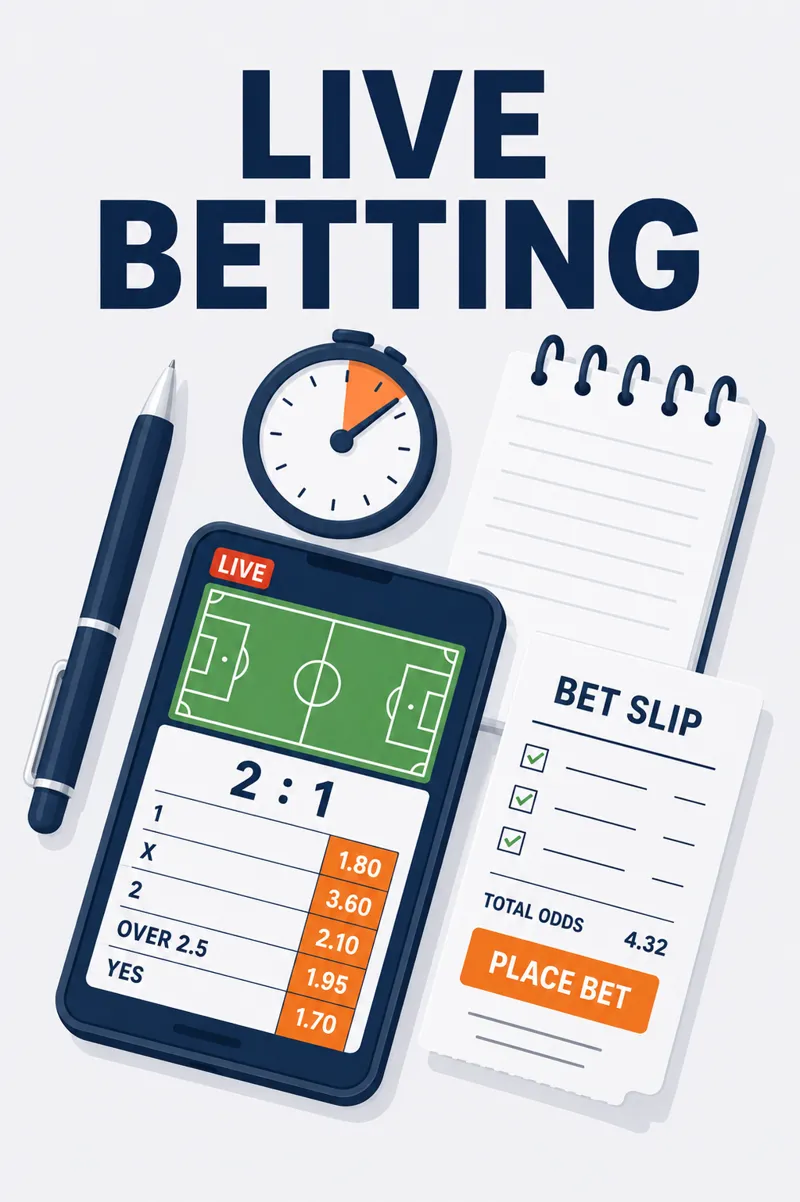
This type of strategy is used as a way to apply more flexible risk control during live sports betting. It may suit bettors who prefer real-time analysis over long-term predictions, but it still requires a stable connection, clear decision-making and a solid understanding of how the sport’s dynamics can change during play.
How Live Betting Works
Examples with Real Numbers
Real Time
Decisions are made during the match, based on how the game develops.
Observation and Analysis
Careful monitoring of match tempo, momentum and live statistics is essential.
Flexible Assessment
The assessment of the odds changes according to the live match situation.
This strategy is based on entering the market after the event has started, when there is more information about the performance of the teams or players. The aim is to identify odds movements that may not fully reflect the current match situation.
Consider a football match where the starting price for "under 2.5 goals" is 1.90. In the 25th minute there are still no goals, and the flow of the game suggests a lower-scoring match. Because time has passed, the odds for the same market have moved to 2.10.
If a bet of R100 is placed at the updated odds of 2.10 and the match ends 0:1, the result would be:
- Total payout if successful: R100 x 2.10 = R210
- Net profit: R210 - R100 = R110
- The success rate is not fixed and depends on the accuracy of the live assessment.
- ROI: (R110 / R100) x 100 = 110% return on this individual bet
Summary table with examples of live bets:
| Time | Market | Odds | Stake | Outcome | Net Profit | ROI |
|---|---|---|---|---|---|---|
| 25' | Under 2.5 goals | 2.10 | R100 | 0:1 | +R110 | 110% |
| 60' | Over 1.5 goals | 1.80 | R50 | 1:2 | +R40 | 80% |
| 70' | Next goal: Away team | 2.50 | R30 | Away goal | +R45 | 150% |
| 30' | Under 1.5 goals | 2.20 | R100 | 2:1 | -R100 | -100% |
Important: This strategy requires a good understanding of sports dynamics and a quick response. If the reaction is delayed or the assessment is wrong, the potential value can disappear quickly.
It is often used in fast-moving sports such as football, tennis and basketball. Bettors may also use live statistics, match trackers or video streams to support real-time analysis.
The approach can be useful when there is a clear strategy, proper preparation and a rational assessment of how the event is developing, without relying on impulse or guesswork.
Advantages of a Live Betting Strategy
One of the main advantages of this strategy is the ability to watch the match in real time. This gives the bettor access to current information about form, momentum and match dynamics that may not be visible in pre-match statistics.
This approach allows for flexible adjustment to changing conditions during the match. A bettor can wait for a suitable moment and react when the market offers odds that appear more attractive than they were before the event started.
Through observation and analysis during play, some risks linked to pre-match predictions can be reduced. This can be useful in uncertain fixtures or matches affected by changing circumstances such as injuries, substitutions or early cards.
In events where the odds move quickly, this strategy can help with better timing of the bet. It is especially relevant for sports with fast-changing situations, including tennis, basketball and football.
With proper preparation and self-control, the strategy supports a structured and analytical approach. Success depends on the ability to recognise patterns, avoid impulsive bets and follow predefined decision criteria.
A live betting strategy may suit bettors who prefer active involvement and quick reaction. It can support more precise assessments and better risk management, provided it is used with enough preparation, discipline and careful observation.
Disadvantages of the Strategy
The need for continuous monitoring of live events can be demanding. Using this strategy effectively requires fast reactions and the ability to make decisions within a short time frame.
With this approach, the betting window is often very limited. If a bettor reacts even a few seconds too late, the market may change, suspend or close, making the strategy harder to execute properly.
The pressure of a live match can lead to emotional reactions. This creates a risk of impulsive bets that do not match the bettor’s original reasoning, analysis or risk limits.
The effectiveness of the strategy can be affected by technical factors, such as streaming delays, slow internet connection or delayed platform updates. These issues can lead to poor timing when placing bets.
Live betting markets may carry higher bookmaker margins than some pre-match markets. This means a bettor usually needs greater accuracy for the strategy to remain sustainable over the long term.
Despite its potential, a live betting strategy comes with clear challenges. It requires concentration, discipline and technical readiness. Without these elements, the chances of consistent long-term results are reduced.
Who This Strategy Is Suitable For
A live betting strategy can be used in different situations and by different types of bettors. It relies on following events while they are in progress and making decisions based on current match conditions, rather than depending only on pre-match predictions.
For beginner bettors, this strategy can help build discipline and reduce rushed decisions. Focusing on the current development of the match limits the need to rely on unsupported assumptions.
For more experienced bettors, it provides an opportunity for real-time analysis and identifying recurring patterns. When used systematically, this can support more consistent and informed decisions.
It is suitable for bettors who can observe match dynamics and recognise key moments when the likelihood of a certain outcome changes. Quick reaction is central to using this strategy effectively.
It can also suit bettors who have limited time, but are able to follow specific matches or selected parts of them. This allows for fewer, more deliberate bets based on the live situation.
Bettors who work with live trends, statistics and in-play patterns may benefit from this approach. The strategy allows for flexible decisions based on real match signals.
This strategy can be useful for those who follow different betting markets, from goals, cards and corners to specific in-play events. It allows the bettor to adapt to what is happening on the field, rather than relying only on the original prediction.
In summary, a live betting strategy is most suitable for bettors who want flexibility, rely on current information and aim for controlled, logic-based betting decisions.
Frequently Asked Questions (FAQ)
It is a betting approach where decisions are made in real time while the event is still in progress. The idea is to use the changing dynamics of the game, including team performance, statistics and participant behaviour, to make more informed betting decisions.
Bettors usually look at factors such as possession, shots on target, cards, current player or team performance and how the odds are moving. The goal is to react to live events in time, without relying only on pre-match analysis.
Understanding the dynamics of the specific sport and being able to make quick decisions are useful. Bettors without experience may face losses if they act too quickly. For that reason, it is better to start with lower stakes and apply strict bankroll control.
The main risks include impulsive decisions, relying on incomplete information and reacting to rapidly changing odds. There is not always enough time for detailed analysis, which can affect judgement and risk management.
Yes, using fixed stakes or predefined limits is generally recommended. This helps reduce losses caused by emotional decisions during high-pressure moments. Good discipline in bankroll management is an important part of the strategy.
This approach is commonly used in football, tennis and basketball. These sports usually provide enough live statistics and in-play events to support better judgement during the match. Access to a live stream can also help with real-time analysis.