


What Is Live Betting Strategy?
Introduction
The live betting strategy is based on observing and adapting to sporting events as they unfold. Unlike pre-match betting, this approach relies on real-time information — including team performance, match dynamics, and live statistics — to support more informed decisions.
This method allows for a more accurate assessment of the situation and can lead to more realistic decision-making, especially in matches where pre-match expectations change. However, it requires active monitoring and the ability to react quickly as the game develops.
Key Features of This Approach:
- Decisions are made in real time, rather than relying solely on historical data.
- Match observation is used to assess the value of the odds as the game progresses.
- There is a greater need for quick reactions and technical readiness when using betting platforms.
- Best suited to bettors who can analyse events in real time and maintain focus throughout the match.
- Works best when market movements do not fully reflect the current state of play.
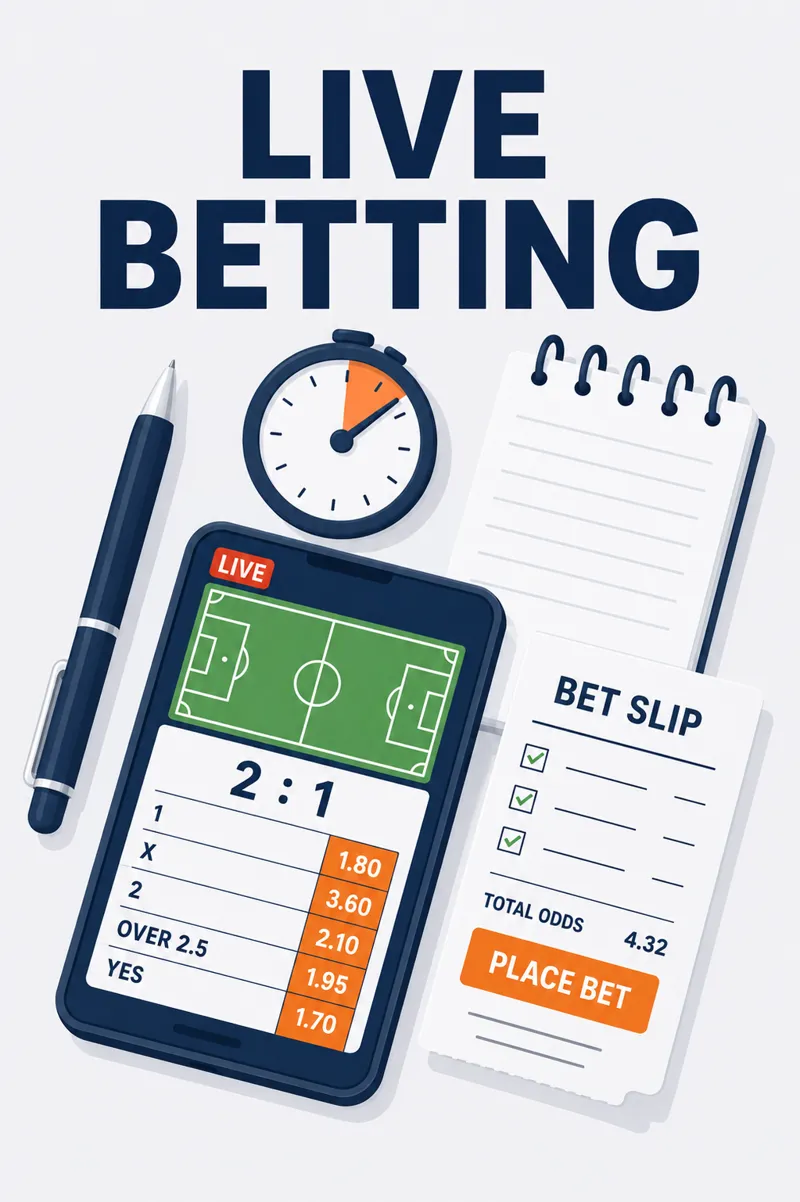
This type of strategy is often seen as a tool for more flexible risk control and is commonly used by bettors who prefer real-time analysis over long-term predictions. However, it requires a stable connection, fast decision-making, and a solid understanding of how sporting events evolve.
How Live Betting Works
Example With Real Numbers
Real-Time Decisions
Decisions are made during the event, based on how the game unfolds.
Observation & Analysis
Careful monitoring of match dynamics and live statistics is essential.
Flexible Evaluation
Odds value is reassessed continuously based on the current game situation.
This strategy involves entering the market after the event has started, when more information is available about team performance or player behaviour. The goal is to identify pricing inefficiencies where the odds do not fully reflect the current state of play.
Let’s look at a practical example. In a football match, the pre-match odds for "Under 2.5 Goals" are 1.90. By the 25th minute, the score is still 0–0, and the tempo suggests a low-scoring game. However, due to the time elapsed, the odds have drifted to 2.10.
If a £100 bet is placed at odds of 2.10 and the match finishes 0–1, the outcome would be:
- Total return: £100 × 2.10 = £210
- Net profit: £210 − £100 = £110
- Outcome success depends entirely on the accuracy of the in-play assessment.
- ROI: (£110 / £100) × 100 = 110% return on this specific bet
Example summary of live betting scenarios:
| Time | Market | Odds | Stake | Outcome | Net Profit | ROI |
|---|---|---|---|---|---|---|
| 25' | Under 2.5 Goals | 2.10 | £100 | 0–1 | +£110 | 110% |
| 60' | Over 1.5 Goals | 1.80 | £50 | 1–2 | +£40 | 80% |
| 70' | Next Goal: Away Team | 2.50 | £30 | Away goal | +£45 | 150% |
| 30' | Under 1.5 Goals | 2.20 | £100 | 2–1 | −£100 | −100% |
Note: This strategy requires a solid understanding of match dynamics and fast execution. Even slight delays or poor judgement can reduce the value of the opportunity.
It is commonly used in fast-paced sports such as football, tennis, and basketball. Additional tools such as live stats and video streams are often used to support decision-making.
The approach can be effective when supported by a clear strategy, preparation, and rational analysis of the game, rather than relying on intuition or impulse.
Advantages of the Live Betting Strategy
One of the main advantages is the ability to watch events in real time. This provides access to current information on form, motivation, and match dynamics that are not fully reflected in pre-match data.
The approach allows for flexible decision-making as conditions change during the event. Bettors can wait for the right moment and act when the market presents value opportunities not available before kick-off.
Through live observation and analysis, certain risks linked to pre-match assumptions can be reduced. This is especially useful in uncertain matches or situations involving injuries or early cards.
In markets with rapid odds movement, live betting offers better timing and positioning. It is particularly effective in fast-paced sports such as tennis, basketball, and football.
When used correctly, the strategy promotes a structured and analytical approach. Success depends on the ability to identify patterns, avoid impulsive bets, and follow predefined criteria.
Overall, live betting suits bettors who prefer active involvement and quick decision-making. It can support more precise evaluations and improved risk management, provided it is applied with discipline and preparation.
Disadvantages of Live Betting
The need for continuous monitoring can be demanding. Successful use of the strategy requires quick reactions and the ability to make decisions within seconds.
The betting window is often very limited. Even a delay of a few seconds can result in odds changing or markets being suspended, making execution more difficult.
The live environment can trigger emotional reactions, increasing the risk of impulsive bets that are not aligned with prior analysis or strategy.
Performance can be affected by technical factors, such as streaming delays or platform latency. This can lead to poor timing and suboptimal bet placement.
In-play markets often involve higher bookmaker margins, meaning a greater level of accuracy is required for the strategy to be sustainable over time.
Despite its potential, live betting presents clear challenges. It requires focus, discipline, and technical readiness. Without these, the likelihood of consistent long-term results is significantly reduced.
Who Is the Strategy Suitable For?
Live betting is suitable for a wide range of situations and bettor profiles. It relies on observing events as they unfold and making decisions based on real-time information, rather than relying solely on pre-match predictions.
For beginners, the strategy can help build discipline and reduce impulsive decisions. Focusing on the live development of the match encourages more structured thinking rather than relying on unsupported assumptions.
For more experienced bettors, it provides an opportunity for real-time analysis and the ability to identify recurring patterns. With a systematic approach, this can lead to more consistent and informed decisions.
It is well suited to those who can read the flow of a game and spot key moments where probabilities begin to shift. Fast reaction time is essential for making the most of these situations.
It can also suit bettors with limited time, who focus only on specific matches or key periods. This allows for fewer but more considered bets, based on actual match conditions.
Bettors who work with trends, statistics, and in-play patterns can benefit the most. The strategy supports flexible decision-making based on real game signals rather than fixed assumptions.
It is particularly effective for those who follow a variety of markets — from goals, cards, and corners to special in-play events. This allows for adaptation to the live situation rather than the initial prediction.
Overall, live betting is best suited to bettors who value flexibility, rely on real-time information, and aim for a controlled, logic-driven approach to betting.
Frequently Asked Questions (FAQ)
Live betting strategy is an approach where decisions are made in real time while an event is in progress. It uses changing match conditions, including team performance, live statistics, and player behaviour, to support more informed betting decisions.
Common factors include possession, shots on target, cards, momentum shifts, player condition, and odds movement. The aim is to react to meaningful changes in the event rather than relying only on pre-match analysis.
Experience helps, especially when it comes to understanding sport-specific dynamics and making quick decisions. Beginners can use live betting, but it is better to start with smaller stakes and strict bankroll control to avoid rushed decisions.
The main risks include impulsive decisions, incomplete information, fast-changing odds, and limited time for analysis. These factors can affect judgement and make risk management more difficult if there is no clear plan.
Fixed stakes and pre-set limits are usually the safest options. They help reduce losses caused by emotional decisions during tense moments. Strong bankroll management and discipline are essential when betting live.
Live betting is most commonly used in football, tennis, and basketball. These sports provide frequent in-play events, useful live statistics, and enough momentum shifts to support real-time analysis.